
The 5 Pedals Every Worship Guitarist Needs on Their Board
Table of Contents
Walk up to almost any worship guitarist’s board and you’ll find the same five categories of pedal, just in different boxes. That’s not a coincidence — it’s because Sunday morning only asks a guitar to do five things well: push from rhythm into lead, even out your dynamics, add a little movement to a sustained chord, repeat a note, and put that note in a room.
I’ve spent over fifteen years building and rebuilding my own board, chasing a tone that serves the room instead of competing with it. Along the way I’ve learned something that surprises people: you don’t need expensive gear to get there. Every pedal on this list is budget-friendly, and every one of them earned its spot through actual use — not hype.
Here’s what those five categories are, why each one matters, and the exact pedals I run on my own board every Sunday.
Top Picks
- Overdrive / Boost: Electro-Harmonix Soul Food shop at zZounds →
- Compressor: JHS Whitey Tighty shop at zZounds →
- Modulation: Walrus Audio Julia shop at zZounds →
- Delay: JHS 3 Series Delay shop at zZounds →
- Reverb: JHS 3 Series Reverb shop at zZounds →
Key Takeaways
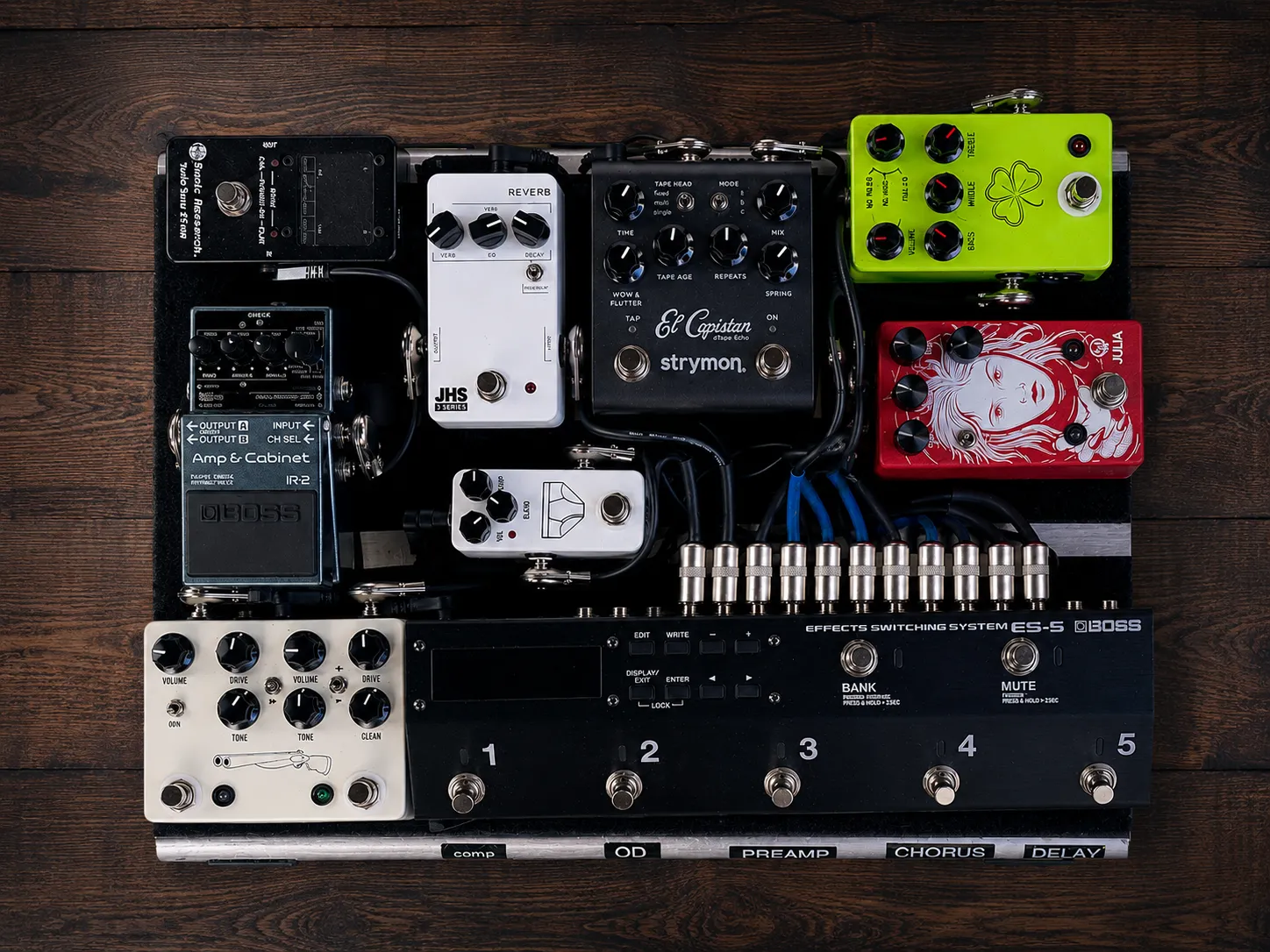
- A worship guitar board needs five core categories — overdrive/boost, compressor, modulation, delay, and reverb — and almost nothing else for a typical Sunday set.
- You do not need premium-priced gear to cover all five. Budget-friendly options from Electro-Harmonix, JHS, and Walrus Audio can fill every slot on a serious worship board.
- Signal chain order matters: dynamics and drive early, modulation in the middle, delay and reverb last — so each effect processes a clean version of the signal before it (Sweetwater).
- A switcher pedal like the Boss ES-5 lets you reorder your signal chain on the fly without rewiring your board — useful for a worship guitarist who plays multiple styles across a single set.
Heads up: this post contains affiliate links (Amazon and zZounds). If you buy gear through one of them, Worship Frontier may earn a small commission at no extra cost to you. Every pedal here is something I actually run on my own board — I only link to gear I’d put in front of my own church.
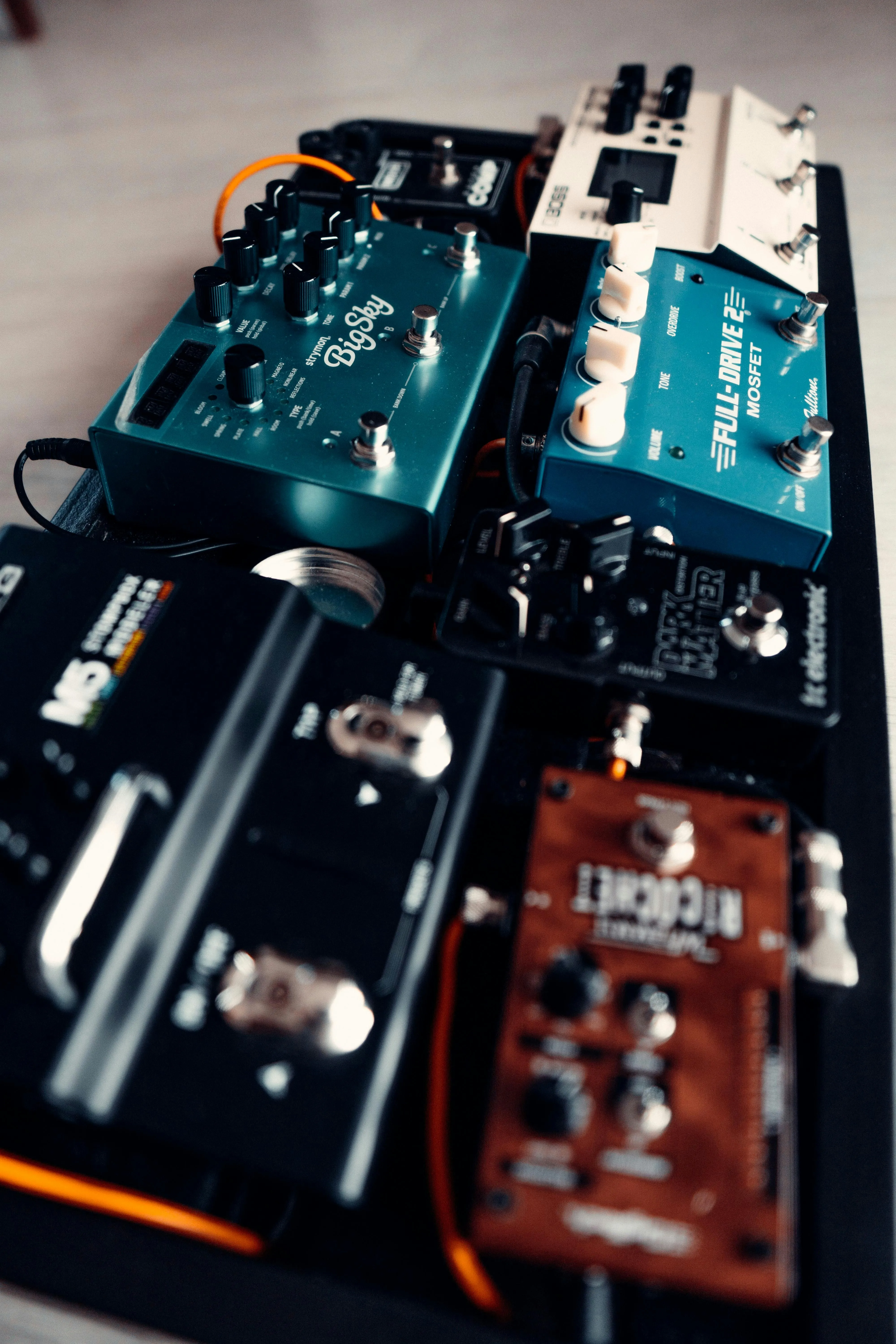
What Belongs on a Worship Guitar Pedalboard?
A worship guitar signal chain typically runs in this order: dynamics (compressor), gain (overdrive/boost), modulation, delay, then reverb — placing time-based effects last so they process the cleanest possible signal (Sweetwater). For most worship contexts, that order can be fully served by just five pedals.
Here’s something most “ultimate pedalboard” articles miss: worship guitar isn’t about having every sound available. It’s about having the right five sounds available instantly, every single Sunday, without having to think about your gear while you’re trying to lead people into God’s presence. A board built around these five categories does exactly that — it disappears, and lets you focus on the room.
If that idea resonates, it’s worth pairing this guide with Your Gear Is a Gift, Not a Goal — a closer look at why tone should always serve the congregation, not the player.
1. Overdrive / Boost — Electro-Harmonix Soul Food
The Electro-Harmonix Soul Food is the pedal I reach for the moment a song needs to move from supportive rhythm into a lead or solo line. It’s based on the transparent-overdrive circuit that made the Klon Centaur famous, but at a fraction of the price — which makes it one of the best values in the entire overdrive category.
What makes it work so well for worship is exactly that word: transparent. It doesn’t reshape your tone, it just pushes it — adding volume and a little grit without making your guitar sound like a different instrument. That’s exactly what you want when the difference between a verse and a bridge needs to happen in a single beat.
The gold standard for this style of overdrive is the legendary Klon Centaur — and the Soul Food is one of the better budget clones of that circuit you’ll find anywhere. I’m a budget guy by nature, and for less than $100, I get a tone close enough that nobody in the congregation can tell the difference. Honestly, what sold me wasn’t a spec sheet — it was a YouTube demo I stumbled across one night that nailed exactly the tone I’d been chasing. I knew within thirty seconds of watching it that this pedal needed to be on my board. If you’d rather shop around first, zZounds has a full lineup of other Klon-style clones worth comparing.
Best for: Worship guitarists who need a transparent push from rhythm to lead — and don’t want to spend Klon money to get it.
If you’re newer to leading worship and still figuring out what gear actually matters before your first Sunday, How to Lead Worship for the First Time is a good place to start before you build out a board like this one.
2. Compressor — JHS Whitey Tighty
A compressor evens out the volume difference between a guitar’s quietest and loudest notes, producing a more consistent, polished tone that sits better in a full-band mix (Sweetwater). For a worship guitarist switching between fingerpicked verses and full-strum choruses, that consistency keeps the congregation’s ears on the song instead of on sudden volume jumps.
The JHS Whitey Tighty is a simple, affordable compressor that does exactly what a worship guitarist needs and nothing more — no deep menus, no programming, just a smoother, more even signal every time you step on it.
I’m a huge Fred Hammond fan, and if you’ve spent any time with his music from the ’90s and early 2000s, you know exactly the kind of funk-inspired guitar lines I’m talking about. When I picked up my first guitar — a custom boutique Telecaster — I wanted to be able to pull those funky, percussive tones out of it on demand. The Whitey Tighty gets me there perfectly. No deep menus, no second-guessing — just step on it and the dynamics even out exactly the way I want them to.
Best for: Worship guitarists who move between quiet, dynamic playing and full-strum choruses and want both to sit evenly in the mix.
3. Modulation — Walrus Audio Julia
A modulation pedal — chorus, vibrato, or tremolo — adds subtle pitch or volume movement that keeps a sustained chord from sounding static, giving a single held note a sense of motion and depth (Sweetwater). On a worship board, that movement is often what turns a plain chord into something that feels alive under a congregation’s voices.
The Walrus Audio Julia is an analog chorus/vibrato pedal known for a lush, three-dimensional shimmer that never feels artificial. It’s the pedal that takes a held chord during a bridge or a quiet moment and makes it feel like it’s breathing.
I first heard this pedal through my lead guitarist at church — I loved the modulation tones he was getting out of it so much that I knew it had to make my board when I built it out. Over the years, I’ve developed a habit of absorbing pieces of the playing styles of guys I’ve shared a stage with and folding them into my own — and the Julia is one of those pieces that stuck. It comes out most during bridges and quieter moments, when a held chord needs to feel like it’s breathing instead of just sitting there.
Best for: Worship guitarists who want sustained chords and clean tones to feel alive, dimensional, and in motion — not flat or static.
4. Delay — JHS 3 Series Delay
A delay pedal records your guitar signal and plays it back after a set interval, creating rhythmic echoes that can turn a simple chord progression into a wash of sound (Fender). Dialed in with a song’s tempo, delay is often the single biggest contributor to the “big,” atmospheric sound associated with contemporary worship guitar.
The JHS 3 Series Delay strips delay down to three simple controls — Time, Repeats, and Mix — which makes it one of the most approachable, budget-friendly delays a worship guitarist can put on a board. No menus, no presets to manage mid-song, just a great-sounding delay you can dial in by feel.
Best for: Building intros, instrumental beds, and the kind of ambient texture that gives a worship set room to breathe — without a steep learning curve.
Want to go deeper on delay specifically? Best Delay Pedals for Worship Guitar walks through the full lineup, including how I think about placing one in the signal chain.
5. Reverb — JHS 3 Series Reverb
A reverb pedal simulates the natural reflections sound makes as it travels through a physical space — a room, a hall, a cathedral — and blends that processed signal back with your dry tone (Fender). If delay is “repeat this note later,” reverb is “make this note sound like it’s happening in a real space” — and that sense of space is often what separates a flat tone from one that feels like it belongs in a sanctuary.
The JHS 3 Series Reverb matches its delay sibling with the same philosophy — three simple controls (Reverb, Tone, Mix) that get you a beautiful, natural-sounding space without ever opening a manual. For a worship guitarist who wants a great reverb without spending an entire paycheck on it, this is exactly the kind of pedal that closes the gap.
My rule of thumb: not too wet. I want it to sound like the room I’m actually in, not like I’m playing inside a cathedral I’ve never set foot in. I keep the mix around 40% at most and lean toward settings that suggest a medium-to-large room — enough space to feel natural, never enough to wash out the song.
Best for: Giving every note — from quiet verses to soaring choruses — a sense of space that supports the room instead of overwhelming it.
If reverb is the piece you’re most particular about, Best Reverb Pedals for Worship Guitar: The Strymon Lineup breaks down the full lineup along with my philosophy on keeping mix levels natural instead of overwhelming.
Bonus: The Switcher That Keeps It All Together — Boss ES-5
Here’s a piece of gear that almost never makes “essential pedal” lists, but it might be the smartest addition to a worship guitar board: a dedicated switching system.
The Boss ES-5 is an effects switcher that lets you route your signal through up to five loops in any order you choose — and recall entire setups with a single footswitch. Instead of being locked into one signal chain, you can rearrange how your pedals interact on the fly, and instantly call up a saved combination for a specific song or moment.
For a worship guitarist running multiple styles across a single set — a quiet acoustic-style opener, a driving anthem, an ambient bridge — that flexibility means you’re never compromising one song’s tone to accommodate another’s. It keeps your board tight, organized, and one tap away from exactly the sound you need.
I came to the ES-5 from a Line 6 setup (more on that below), and I wanted that same kind of simplicity for my analog board. The ES-5 is old-school in the best way — it works exactly how you set it up, and once it’s dialed in, it just runs.
I keep all my pedals on and let the ES-5 manage the order, so I never have to think about signal chains mid-set. The one exception is my overdrive — I keep the Soul Food right up front and use its own stomps when I need a quick change there.
Having a switcher on the board is, hands down, one of the best investments I’ve made. It takes the guesswork out of ordering and lets me focus on playing instead of managing my rig. Here’s a demo that shows exactly how it works in practice:
Best for: Worship guitarists running several distinct tones across a set who want total control over their signal chain without rewiring their board every week.
How They Work Together
| # | Category | Pick | What It Does | Where It Sits in the Chain |
|---|---|---|---|---|
| 1 | Overdrive / Boost | EHX Soul Food | Pushes rhythm tone into lead territory | Early |
| 2 | Compressor | JHS Whitey Tighty | Evens out dynamics for a polished tone | Early–mid |
| 3 | Modulation | Walrus Audio Julia | Adds shimmer and movement to sustained chords | Mid |
| 4 | Delay | JHS 3 Series Delay | Creates rhythmic, atmospheric echoes | Late |
| 5 | Reverb | JHS 3 Series Reverb | Places your guitar in a sense of space | Last |
My board, in order: Soul Food → Whitey Tighty → Julia → JHS 3 Series Delay → JHS 3 Series Reverb, all routed through a Boss ES-5 so I can reorder or bypass any of them on the fly depending on the song. I keep the Soul Food right at the front of the chain — that’s the one pedal I still adjust by hand mid-song, so it stays within easy reach.
Prefer One Box to Five? Consider an All-in-One Modeler
Everything above assumes you want to build a traditional pedalboard, one box at a time. But that’s not the only path — and for some worship guitarists, it’s not even the best one.
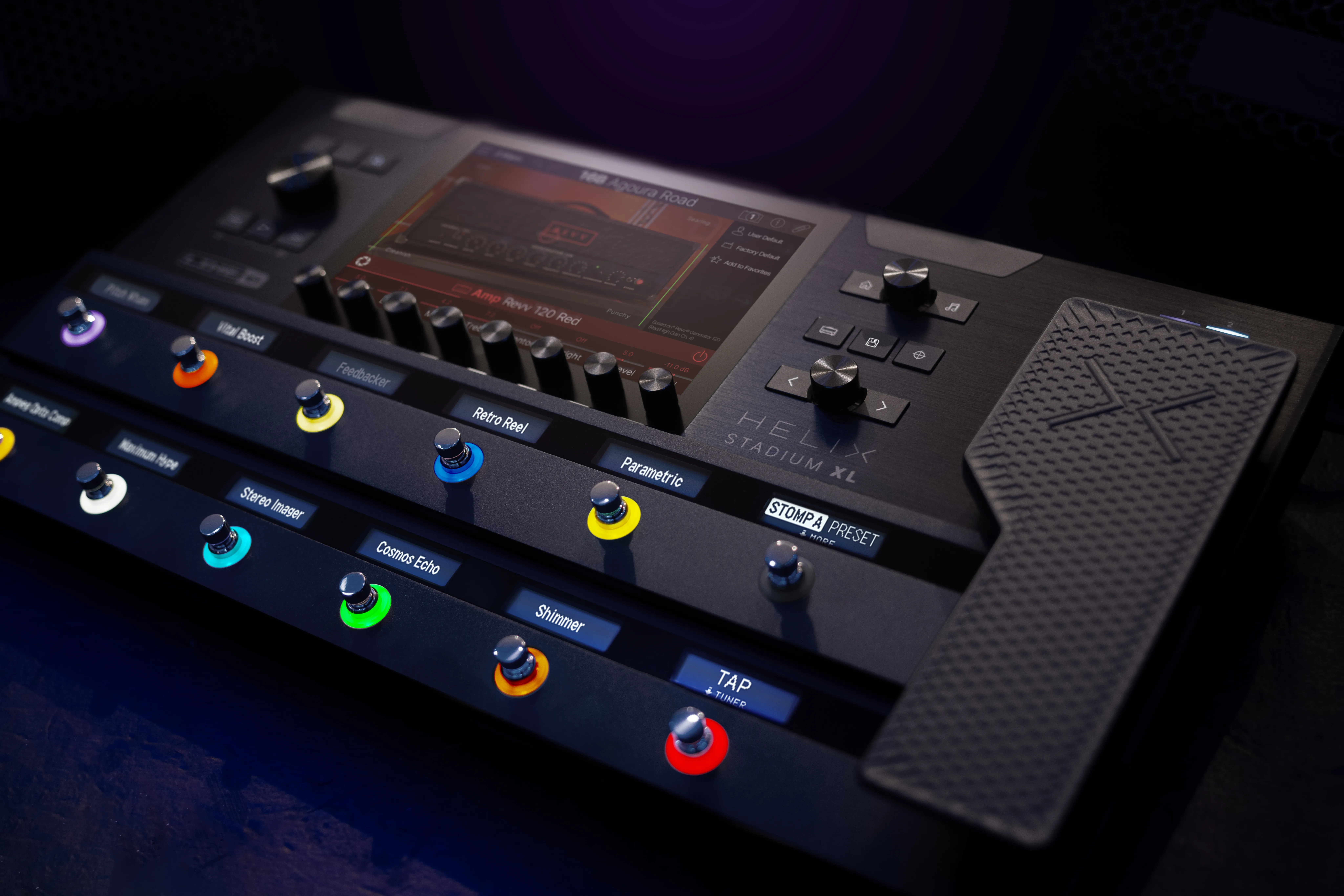
An all-in-one modeler like the Line 6 Helix Stadium packs overdrive, compression, modulation, delay, reverb, and dozens of other effects into a single unit, with the ability to save and instantly recall a complete signal chain for every song in your set. Instead of five pedals, a power supply, patch cables, and a switcher, you get one box, one cable to the amp or board, and total recall — the same dialed-in tone, every single Sunday, with zero risk of a single component failing mid-set.
The Stadium line comes in two formats, depending on how you like to interact with your rig:
- Line 6 Helix Stadium XL — the full-size unit with an expanded control surface, larger display, and the most hands-on footprint in the lineup
- Line 6 Helix Stadium — the floor-model version, built for guitarists who want the same modeling power in a stage-ready footswitch format
Funny enough, an all-in-one modeler is exactly where my own pedal journey started. When I first joined a contemporary worship band, I noticed the guys on the team were running Line 6 POD Live XT boards, and their tone was excellent.
When I asked where they got them, they pointed me to the used market and gave me advice I still pass along: if you’re playing and singing at the same time, you don’t want to be fumbling with a pedalboard — get an all-in-one. I found two of them on Reverb for around $120 each — an incredible deal — and grabbed both.
I needed two anyway, since I was getting involved with a ministry that hosted retreats, and it was a lot easier to keep one set up in the retreat room and another in the chapel than to break down and haul gear between them. Because they’re software-based, I loaded identical presets onto both, and I could walk into either room with just a guitar and have my full sound waiting for me.
(You can still find a few of these on Reverb if an all-in-one sounds like the right move for you, too.) That experience is exactly why I’d tell any worship guitarist to seriously weigh a modeler like the Helix Stadium before assuming a traditional board is the only way to go.
Best for: Worship guitarists who travel between venues, play on multiple teams, or simply want one reliable unit that replaces an entire board — without sacrificing tone quality or flexibility.
The trade-off worth knowing: a traditional pedalboard lets you reach down and tweak a single knob mid-song by feel. A modeler asks you to commit to your settings in advance and trust them. Neither approach is wrong — it comes down to whether you’d rather have hands-on control or set-it-and-forget-it consistency on a Sunday morning.
A Few Principles Worth Keeping
Fewer, better pedals beat more, expensive ones. Every pedal on this list is budget-friendly — proof that a board of five thoughtfully chosen pedals will consistently outperform a board of twelve impulse purchases, regardless of price tag.
Know your signal chain — or let a switcher manage it for you. The order pedals sit in changes how they sound together. Dynamics and gain early, modulation in the middle, time-based effects (delay, then reverb) last (Sweetwater). A switcher like the ES-5 means you’re never locked into one order.
Build for Sunday, not for the practice room. A pedal that sounds incredible alone in your living room can disappear — or worse, clash — in a full band mix with vocals, drums, and keys. Test everything in context before it earns a permanent spot.
Simplicity serves the moment. The best worship tone is the one you don’t have to think about. If you’re adjusting knobs mid-song, the gear has become the focus instead of the room you’re called to lead.
For the full philosophy behind why any of this matters, Your Gear Is a Gift, Not a Goal is worth reading before you buy another pedal — it’s the piece that keeps tone in its proper place behind the purpose of leading worship.
Frequently Asked Questions
What pedals does a beginner worship guitarist actually need?
An overdrive/boost pedal and a reverb pedal are the two most essential starting points — together they cover the rhythm-to-lead push and the atmospheric quality that defines the modern worship guitar sound. From there, a delay pedal and a compressor round out a board capable of handling most worship contexts (Sweetwater).
What order should worship guitar pedals go in?
The widely recommended order is dynamics (compressor) and gain (overdrive/boost) first, modulation in the middle, then delay and reverb last — so time-based effects process the cleanest possible signal (Sweetwater). A switcher pedal like the Boss ES-5 lets you experiment with that order without rewiring your board.
Do I need both a compressor and a modulation pedal?
It depends on the tone you’re chasing, but many worship guitarists run both for different reasons — a compressor for consistent, polished dynamics across quiet and loud passages, and a modulation pedal for subtle movement and shimmer on sustained chords. They solve two different problems, not the same one.
How many pedals should a worship guitar board have?
Five well-chosen pedals — overdrive/boost, compressor, modulation, delay, and reverb — will cover the overwhelming majority of modern worship contexts. Adding a switcher pedal can extend that board’s flexibility further without adding tonal clutter.
Is it worth spending more on fewer pedals?
Not necessarily — budget-friendly options from brands like Electro-Harmonix, JHS, and Walrus Audio can cover every essential category on a worship board without the premium price tag. What matters more is that each pedal is chosen specifically for how you actually play, not how impressive it looks on a list.
Once your tone is dialed in, the next question is what you’re actually going to play through it — and My CCLI Worship Song Library walks through the 200+ songs I keep in rotation and the philosophy behind choosing what stays and what goes.
For more on building out a worship guitar rig piece by piece, see the best delay pedals for worship guitar and the best reverb pedals for worship guitar — both go deeper into the two categories that shape the “worship sound” the most.
A Prayer for the Worship Guitarist
Father, thank You for the gift of music and for every guitarist who picks up an instrument to lead Your people into Your presence. Bless their hands, sharpen their ears, and let every pedal, every tone, and every note serve one purpose — pointing the room back to You. Let the sound never become the point; let it always be the doorway. Amen.
Be Blessed,
Mark Claiborne

Find this helpful?
Writing takes time. If Worship Frontier has been useful to you, buying me a coffee means a lot — and keeps this going.
Join the Conversation
Comments are moderated — approved ones are posted periodically.
Thanks for your comment — it's in the queue for review.